I always wanted to be a pharmacy owner.
In 2012, I was a pharmacy intern in Melbourne, and China was still suffering from the notorious baby formula scandal that left many 300,000 infants sick and six dead (BBC News Services 2020, para. 4). Consumer confidence in local made products was hit to the bottom. Friends and relatives started to ask me to send them high quality Australian Made products back to China. Gradually more and more people followed me on WeChat through others’ recommendations to purchase Australian products, and I started to see it as a career opportunity.
Back then, I had no concept of self promotion or self presentation, as discussed by Marshall (2010, p38-39). I only felt that in order for people to trust me and buy my products, I had to put myself out there in the public. So, I built a Weibo account, a WeChat Public account and an online store, and I put up lots of photos of my lives in Australia on these platforms to tell people that I am actually in Australia and I am selling authentic products. After six years of hard work, I paid the deposit of my first pharmacy from what I made on these platforms by selling quality products. My dream came true.
Out of all the platforms that I use for self-production, WeChat definitely plays the key role. It is where I engage with customers, transform potential customers to regular customers. It is also where I build trust and relationships. Up to now, I have more than 20,000 loyal customers, and the number is still increasing. You might wander how I did this? The strategies that I use can be categorised into three major parts.
Part One – Find the Right Audience

Smith & Watson (2014, p74-75) has outlined the role of audiences in network platforms. My desired audiences are those Chinese middle-class consumers who pursue the best possible health solution. These people who actively reach out to me through WeChat are my targeted audience. They have the intention to buy, they need the quality products, and most likely they can afford the products.
A substantial amount of my WeChat friends come from ‘live-streaming’ platform on Taobao, usually I have at least 500 people watching for each session. Live streaming makes my audiences ‘feel closer to me’, said by one of my loyal customers who friended me on WeChat after seeing me on live streaming. She also said the way I talk is ‘authentic, professional and lovely’.
Part Two – Make Presence
I present myself through creating daily moments on WeChat. My online identity and my products are inseparable in a way that many of my customers buy my products because they trust me and like me. I make sure that my daily releases add value to my audiences, they include professional evaluation of healthcare products, analysis of health problems and promotions of healthier life.
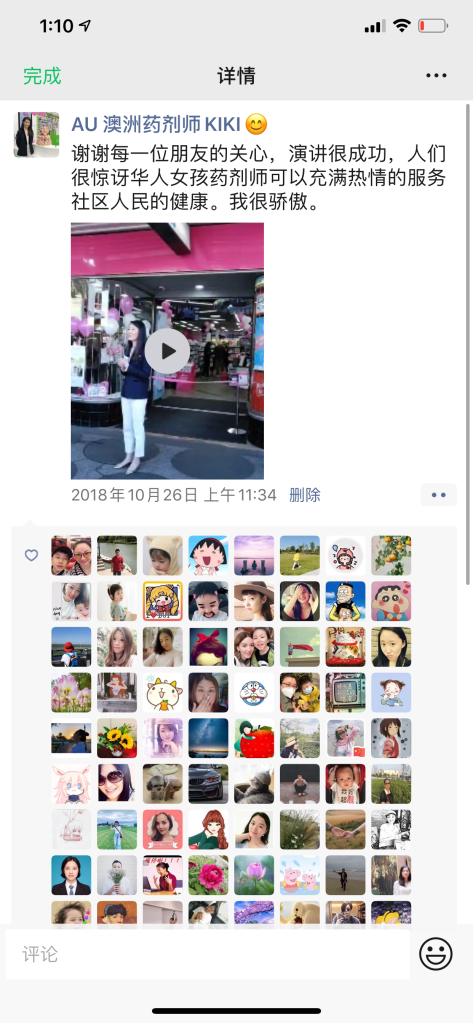
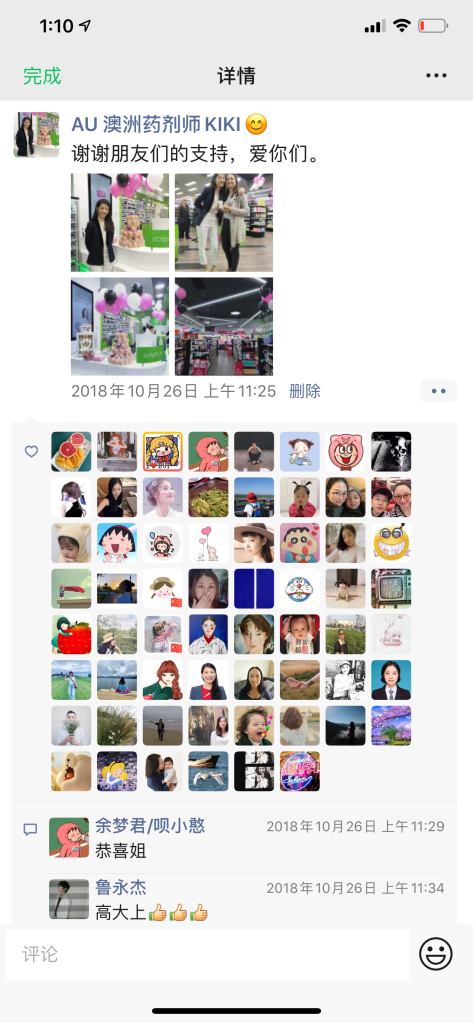
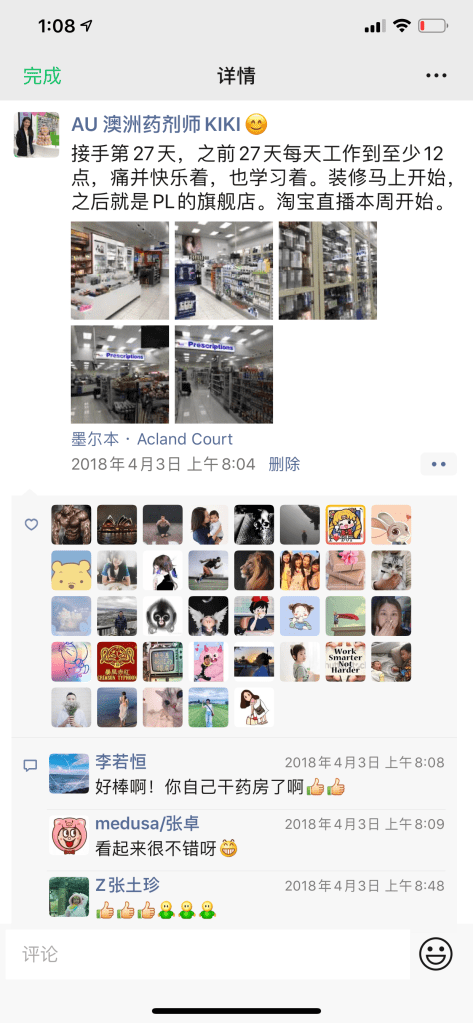
I never put up many sales advertisements ‘harass’ my contacts, instead I mange my contents through strategic planning. I make a part of my ‘personal but not private’ life public, for example the selfies I do, the emotions I feel, or the activities I take. All these helps to build ‘calculated authenticity’ (Jeff Pooley, 2011). These following screen shots are typical moments that I publish on WeChat.
Part Three – Provide Invaluable Personalised Customer Service
I am strategically active in WeChat all the time, when my customers are ready to buy, they will think of me, and my team and I will provide invaluable personalised pre- and after-sale services.
To build a successful online identity on WeChat involved many other things, from naming the ID, to design of your logo, to participation of current issues to gain popularity. One of my WeChat ID is ‘chemist’, and this ID attracts followers automatically because literate audiences would search this keyword, and the word ‘chemist’ itself already represents some degree of authority.
I will keep you updated with what I do to manage my social platforms, and how I go with building a team just to mange social platforms. If you are interested, please follow me on links below or subscribe to my updates.
References
BBC News Services 2010, China dairy products found tainted with melamine, retrieved 5 May 2020, < https://www.bbc.com/news/10565838>.
Marshall, PD 2010, ‘The promotion and presentation of the self: celebrity as marker of presentational media’, Celebrity Studies, vol. 1, no. 1, pp. 38-39
Pooley, J 2011, “Authentic” Get Real.” Quoted in the New York Times, Sunday Style Section, September 11,1-2
Smith, S and Watson, J 2014, ‘Virtually Me: A Toolbox about Online Self-Presentation’, inPoletti, A and Rak, J (eds.), Identity Technologies: Constructing the Self Online, The University of Wisconsin Press, Madison, pp. 74-75
 Kiki Collection